Playwright vs Selenium vs Cypress: 2026 Comparison
End-to-end testing in 2026 is no longer just about checking whether a button click works. Modern applications rely on asynchronous UI rendering, component-driven architecture, API-heavy interactions, dynamic state management, and browser-specific behavior, so teams now expect their testing framework to provide speed, resilience, cross-browser coverage, observability, and smooth CI/CD integration at the same time. That is exactly why Playwright, Selenium, and Cypress continue to dominate the test automation conversation in 2026, even though they take very different approaches to solving the same problem.
Among the three, Playwright has become the most modern all-around choice for many engineering teams because it combines cross-browser support, integrated tooling, auto-waiting, tracing, and test isolation in one framework. Selenium remains highly relevant where enterprises already have large legacy automation estates and need long-term language and browser flexibility, while Cypress still appeals to frontend-centric teams that value fast local feedback and a highly visual testing workflow. The right choice in 2026 depends less on popularity alone and more on architecture, scale, team skill set, and long-term maintenance cost.
For related depth on SDETLab, see the agentic AI testing primer, prompt engineering for test automation, and practical tools such as the AI test case generator and test data generator.
Why this matters in 2026
Testing frameworks now influence release velocity directly because unstable automation slows deployment pipelines and erodes trust in CI results. A flaky suite does more than waste time; it creates hesitation around shipping, increases investigation overhead, and gradually trains teams to ignore failures that might actually matter. In a fast delivery environment, reliability becomes a product and platform concern, not just a QA concern.
At the same time, browser automation has become more demanding. Teams need to validate customer journeys across browser engines, emulate devices, inspect network behavior, reuse authenticated state, and debug failures in remote CI runs without reproducing everything locally. Frameworks that reduce synchronization errors and provide stronger visibility into test execution are therefore much better aligned with modern engineering workflows.
Playwright
Playwright is an open-source framework created by Microsoft for web automation and testing, and its official repository describes it as a framework that drives Chromium, Firefox, and WebKit with a single API. It includes Playwright Test, a built-in runner designed for end-to-end testing with browser isolation, parallelism, auto-waiting, and web-first assertions. That official product direction is one reason Playwright is often seen not just as a browser driver, but as a complete testing platform. Official entry points: Playwright documentation and the microsoft/playwright repository on GitHub.
Playwright also extends beyond local test execution. Microsoft offers Playwright Testing as a cloud-based service, which signals that Playwright is being positioned for scaled execution, centralized reporting, and broader enterprise workflows rather than only developer laptop use cases. Adobe’s developer ecosystem also references Playwright-based end-to-end testing practices, which supports the view that Playwright is being used in serious product environments.
Selenium
Selenium remains the most established browser automation framework in the market and is still widely associated with large-scale enterprise test programs. The SeleniumHQ repository describes it as “a browser automation framework and ecosystem,” which reflects its long-running role as the baseline technology for browser automation across many languages and infrastructures. Its continued relevance comes from ecosystem breadth, flexibility, and a long history of adoption in enterprise software delivery. Authoritative sources: Selenium documentation and SeleniumHQ/selenium on GitHub.
Selenium is especially strong when organizations already have mature internal tooling around it. Teams with large Java-based suites, custom framework layers, and established Grid infrastructure may accept higher complexity because the migration cost to a new stack is significant.
Cypress
Cypress built its reputation by making browser testing feel more approachable and more visible to frontend engineers. It remains a TypeScript-based open-source project focused on making browser testing fast, easy, and reliable, with strong repository activity and a large developer following. Its interactive runner and developer-friendly command style helped it become one of the most recognizable tools for frontend testing. Start here: Cypress documentation and the cypress-io/cypress repository.
Even so, Cypress is more specialized than some teams initially expect. It remains compelling in JavaScript-heavy environments, but the moment a team needs broader browser validation or more flexible execution patterns, Playwright or Selenium often re-enter the conversation.
Architecture
Architecture explains most of the practical differences between these tools. Test syntax is the visible part, but the execution model determines whether a framework feels fast, flaky, scalable, or difficult to debug in real projects.
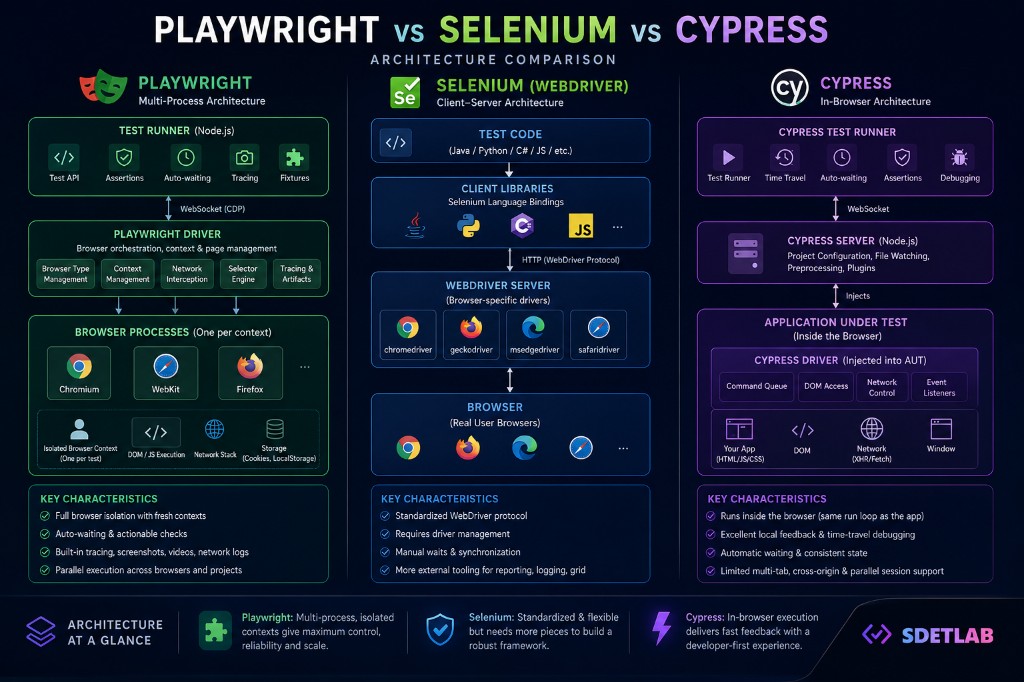
Playwright uses a tightly integrated model that gives it strong control over browser execution and enables features like auto-waiting, fresh browser contexts for each test, tracing, and cross-browser projects in one unified framework. Its official documentation emphasizes full browser isolation, parallel execution, actionable element waits, and trace capture with DOM snapshots, network requests, screenshots, and console insight. This architecture is one of the main reasons Playwright has gained momentum among teams building modern web applications.
Selenium uses the WebDriver approach, which is standardized and widely supported. That standardization is valuable, but it also means teams often need more surrounding framework code and more discipline around waits, driver management, reporting, and infrastructure compared with Playwright’s built-in experience.
Cypress uses an in-browser style of execution that creates an excellent local feedback loop. That closeness to the application runtime helps Cypress shine during frontend development, though it also contributes to some of the tool’s practical constraints when broader browser or session coverage becomes necessary.
Browser support
Browser support remains one of the clearest dividing lines in 2026. Playwright officially supports Chromium, Firefox, and WebKit, which means teams can test across the three major browser engine families through a single API and a single framework workflow. That matters for customer-facing products where rendering, storage, and interaction behavior still differ meaningfully across engines.
Selenium also remains strong in cross-browser scenarios because of its broad WebDriver ecosystem. For teams with established browser labs, enterprise compliance requirements, or long-running cross-browser programs, Selenium continues to be a practical option even if developer ergonomics are not as streamlined.
Cypress is still strongest in workflows centered around modern frontend development rather than broad browser validation. That makes it productive in the right environment, but less attractive for teams that need wide browser confidence as a core business requirement.
Reliability and flakiness
In production automation, test stability matters more than elegant syntax. Teams can tolerate a learning curve more easily than they can tolerate a suite that randomly fails under load or behaves differently between local execution and CI.
Playwright’s official documentation explicitly highlights auto-waiting, web-first assertions, and retries until conditions are met, which directly addresses one of the biggest historical causes of UI test flakiness: trying to interact with an element before it is truly ready. Playwright also isolates each test in its own browser context, which helps reduce side effects and state leakage across runs. Those design choices make Playwright attractive to teams that want less fragile automation without building elaborate synchronization logic themselves.
Selenium can absolutely be stable, but stability depends more heavily on team discipline. Good Selenium suites usually require carefully designed waits, resilient locators, consistent environment control, and mature reporting patterns, which adds engineering overhead as suites grow.
Cypress improves reliability relative to brittle traditional UI scripts through retries and a strongly guided execution model. But once testing requirements expand beyond its ideal operating model, teams may find that the framework’s strengths are concentrated more in developer experience than in maximum flexibility.
Developer experience
Cypress deserves real credit for changing expectations around test authoring. Its local runner, visible command chain, and highly readable syntax made it much easier for frontend developers to participate in UI automation instead of treating it as a specialized QA function. That developer-first design remains one of its biggest strengths.
Playwright, however, now offers a similarly strong experience while reaching further into production-scale concerns. The official Playwright repository documents code generation, trace viewing, locators based on user-facing semantics, built-in parallelism, device emulation, and integrated debugging support inside VS Code. That combination helps Playwright appeal not only to testers, but also to full-stack engineers and platform teams that need a single framework for local development, CI execution, and failure analysis.
Selenium’s developer experience depends more on the framework a team builds around it. A well-engineered Selenium stack can still be productive, but it rarely feels as cohesive out of the box as Playwright or as immediately friendly as Cypress.
Parallelism and scaling
Scaling a test suite is not just about raw execution speed. It is also about how cleanly a framework handles isolation, distribution, browser management, and failure analysis as the suite grows from dozens of tests to hundreds or thousands.
Playwright’s official documentation states that tests run in parallel by default and that each test gets a fresh browser context with near-zero overhead. That is a major advantage because it lets teams scale without introducing as much custom framework logic as they often need elsewhere. Microsoft’s Playwright Testing service further reinforces that Playwright is being positioned for larger execution models, not only local experimentation.
Selenium is still capable of very large-scale execution, especially with Grid-based infrastructure. But that usually comes with more moving parts and a greater operational burden on the engineering team. Cypress can scale as well, but teams often find its ideal use case narrower when they compare long-term execution flexibility across browser and infrastructure requirements.
Debugging and observability
Debugging quality often determines whether a framework feels production-ready. In CI, a test failure that cannot be understood quickly is nearly as expensive as a flaky test because it delays decisions and increases engineer interruption.
Playwright is particularly strong in this area because trace capture is part of the framework’s core value. The official repository describes trace viewer support that can show every action, DOM snapshot, network request, console message, screenshot, and video context associated with a failure. That level of visibility is unusually valuable when diagnosing failures that only appear in remote environments.
Cypress also provides an excellent visual debugging workflow, especially during local development. Selenium can support robust diagnostics too, but that experience usually depends more on the custom reporting and observability layers a team chooses to build.
GitHub repository signals
GitHub repository data is not a full measure of framework quality, but it is a useful public indicator of mindshare, contributor activity, and ecosystem momentum. In 2026, microsoft/playwright shows 86.7k stars, 5.5k forks, 160 releases, 721 contributors, and more than 458k GitHub dependents on the repository page. Those are very strong ecosystem signals for a testing framework that is still younger than Selenium.
SeleniumHQ/selenium shows 32.3k stars and 8.4k forks, which reflects a mature and widely established open-source ecosystem with long-term industry presence. cypress-io/cypress shows roughly 49.6k stars and over 3.3k forks in public analytics, which confirms that Cypress still holds a large and active place in frontend testing conversations.
| Repository | Public signal | What it suggests |
|---|---|---|
| Playwright | 86.7k stars, 5.5k forks, 721 contributors, 160 releases | Very high momentum, strong contributor base, rapid iteration |
| Selenium | 32.3k stars, 8.4k forks | Mature, established ecosystem with long enterprise history |
| Cypress | About 49.6k stars, about 3.4k forks | Strong developer mindshare, especially in frontend-oriented teams |
These metrics do not prove technical superiority by themselves, but they do reinforce the broader market pattern: Playwright has strong current momentum, Selenium remains deeply entrenched, and Cypress continues to hold a significant share of developer attention. Stars, forks, and dependents change over time; treat the numbers as a snapshot, not a scorecard.
Public brand references
Microsoft is the clearest example because it created Playwright, documents it publicly, and offers Playwright Testing as a cloud service. Adobe is another safe reference because its developer documentation includes Playwright-based end-to-end testing material in its application ecosystem.
Microsoft’s direct investment in Playwright and Adobe’s public developer documentation around Playwright-based testing indicate that the framework is established in real modern engineering workflows.
When to choose each tool
Choose Playwright when the goal is modern, production-ready, cross-browser automation with strong debugging, integrated tooling, and a lower-maintenance waiting model. It is especially well suited for greenfield projects, customer-facing web applications, CI-heavy delivery teams, and engineering organizations that want one framework to handle execution, reporting, and observability cleanly.
Choose Selenium when an organization already has a large automation estate, depends on broad language flexibility, or must preserve long-standing enterprise infrastructure. Selenium remains practical when migration cost outweighs the short-term value of modernization.
Choose Cypress when a team is deeply frontend-centric, values immediate local feedback, and operates mainly in a JavaScript-driven workflow. It is strongest where developer ergonomics matter more than the broadest possible browser and infrastructure coverage.
Final view
Playwright, Selenium, and Cypress all remain relevant in 2026, but they are no longer equally compelling for the same kinds of problems. Selenium is still the dependable incumbent for large legacy programs, Cypress remains highly attractive for frontend-focused development teams, and Playwright has become the strongest all-around choice for modern browser automation because it combines cross-browser support, integrated tooling, parallelism, auto-waiting, and rich debugging in one platform.
Playwright is the most future-facing option for new automation initiatives, Selenium remains the practical long-term choice for many existing enterprise environments, and Cypress is a focused tool that excels when team priorities lean heavily toward frontend developer productivity.